Mechanical Design 101
  • BLOG
  • VIDEOS
  • SHOP
    • Specialty items
    • Books
    • Mobile Apps
    • Software
  • RESOURCES
    • MACHINE DESIGN
    • LINKAGE DESIGNS
    • ENERGY AND ENVIRONMENT
    • DESIGN INNOVATION
    • ROBOTICS
    • Smitty and the Professor
    • Lecture Notes
    • CREATIVE
    • Need Help?
    • Uncategorized
  • ABOUT
    • Need Help?
  • Click to open the search input field Click to open the search input field Search
  • Menu Menu
  • Shopping Cart Shopping Cart
    0Shopping Cart
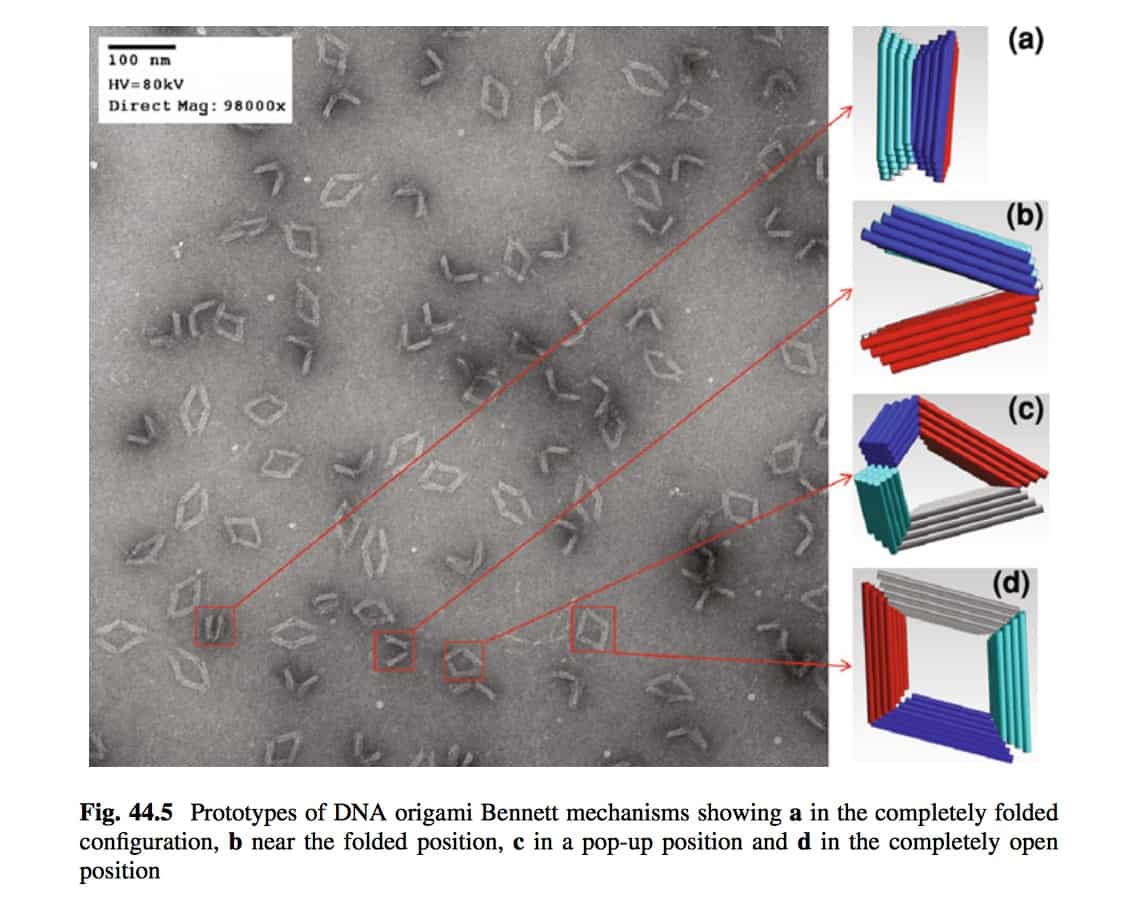
DNA origami mechanisms, Advances in Reconfigurable Mechanisms and Robots, Springer 2012

DNA Origami Mechanisms and Machines
October 21, 2014/0 Comments/by Chris McCarthy
DNA origami mechanisms, Advances in Reconfigurable Mechanisms and Robots, Springer 2012

DNA origami mechanisms from Advances in Reconfigurable Mechanisms and Robots, Springer 2012

Professors Carlos Castro and Haijun Su have developed what they call DNA Origami Machines and Mechanisms to pave the way for new small scale devices that could revolutionize medicine, manufacturing, and environmental sensing.

DNA Mechanisms made from links of relatively rigid dsDNA bundles joined by soft ssDNA strands have the potential to provide machines for molecular transport in bioreactors, targeting cancer cells for drug delivery, or even repairing damaged tissue.

Protein is an attractive material for machine construction because there is a huge range of naturally occurring protein-based molecular machinery, but it has been difficult to control proteins structures due to the multitude of complex amino acid interactions that govern protein folding. DNA, however, self-assembles by base pairing and base stacking interactions, natural processes that these researchers essentially “plug in to” to create, manipulate, and “tune” compliant structures. This has led to research on how to use DNA in machine design.

The recent development of scaffolded DNA origami has enabled the construction of nanoscale objects with unprecedented 3D structural complexity by self-assembly. To quote Professor Su’s paper, “We … locally bend bundles of double-stranded DNA into bent geometries whose curvature and mechanical properties can be tuned by controlling the length of ssDNA strands.” This demonstrates a mechanical model that predicts both their geometry and mechanical properties.

As Professor Su states, they are working to “provide a basis for the design of mechanically functional DNA origami devices and materials.” DNA origami mechanisms open an interesting frontier in machine design at the nano level. It is a continuance of mechanical progress that has been a part of engineering for centuries with a potential that until now has been merely the subject of science fiction.

References:

DNA Origami Compliant Nanostructures with Tunable Mechanical Properties: Lifeng Zhou, Alexander E. Marras, Hai-Jun Su, and Carlos E. Castro, Dec. 18, 2010

Design and Fabrication of DNA Origami Mechanisms and Machines, Haijun-Su, Carlos Ernesto Castro, Alexander Edison Marras, Michael Hudoba; Advances in Reconfigurable Mechanisms and Robots, 2012, pp. 487-500
Tags: design innovation
Share this entry
  • Share on Facebook
  • Share on X
  • Share on Pinterest
  • Share on LinkedIn
  • Share on Tumblr
  • Share on Vk
  • Share on Reddit
  • Share by Mail
https://mechanicaldesign101.com/wp-content/uploads/2014/10/SpringerVerlag-Reconfigurable-Mechanisms.jpg 898 1132 Chris McCarthy https://mechanicaldesign101.com/wp-content/uploads/2016/07/mechanical-design-101LOGOf.png Chris McCarthy2014-10-21 14:51:592017-04-14 14:31:23DNA Origami Mechanisms and Machines
You might also like
Target Profiles for Morphing Linkage Actuating Morphing Linkages
Bernie Roth Bernard Roth: The Achievement Habit
Disney Prototyping System Linkage Synthesis at Disney Research Zurich
screenshot MechGen FG App Makes Design Calculations Easy
Fourbar Extrusion A four-bar linkage provides a shape changing extrusion die
Demining Training Aids 3D Printed Demining Training Aids
0 replies

Leave a Reply

Want to join the discussion?
Feel free to contribute!

Leave a Reply

You must be logged in to post a comment.

This site uses Akismet to reduce spam. Learn how your comment data is processed.

Search

Search Search

Recent Blog Posts

  • Innovative Car Door Linkage
  • Spherical Linkage Opening a Jewelry Box
  • Red Lines, Part 6
  • Red Lines, Part 5
  • Red Lines, Part 4
  • Exponential Threat, Part 4
  • Exponential Threat, Part 3
  • Red Lines, Part 3
  • ZotSun: UCI Entry in the Formula Sun Grand Prix
  • UCI Anteater Baja Racing: Five Months to the Competition

Post Categories

  • Automotive Information
  • Bored Robot
  • Chop wood carry water
  • Commentary
  • Creative
  • Design Innovation
  • Energy and Environment
  • Engineering Data
  • Fabrication
  • Give Me Space
  • Kinematic Synthesis
  • Kinematics
  • Lecture Notes
  • Linkage Animations
  • Racecar Engineering
  • Red Lines
  • Robotics Information
  • Smitty and the Professor
  • Student Projects
  • Superluminal
  • UCI Energy Invitational
  • Uncategorized

Events Calendar

October 2014
S M T W T F S
 1234
567891011
12131415161718
19202122232425
262728293031  
« Sep   Nov »

Project-based Learning (links)

  • Energy Invitational
  • Performance Engineering
  • Smitty and the Professor
  • The California Challenge
  • Theoretical Kinematics
© Copyright - Mechanical Design 101
Web Design by Lucky 19
  • Link to Facebook
Link to: MechGen FG App Makes Design Calculations Easy Link to: MechGen FG App Makes Design Calculations Easy MechGen FG App Makes Design Calculations Easyscreenshot Link to: Lamina Emergent Mechanisms Link to: Lamina Emergent Mechanisms Lamina Emergent Mechanisms
Scroll to top Scroll to top Scroll to top